Training paradigm biases
- Ivyer Mingwei Qu, Jiayue Dora Li, Yuqing Zhu. (2026). The Role of Training Paradigms in Shaping Connectivity and Dynamics: A Comparison of Gradient-Based and Evolutionary Methods in Recurrent Neural Network Models. bioRxiv. https://doi.org/10.64898/2026.07.09.737022.
Task-trained Recurrent neural network models (rNNs) often exhibit low-dimensional dynamics (for those new to this concept, you can think of it as many neurons collaborating to do kinda redundant things together). this result has influenced theories of real neural computation and been corroborated by experimental data. However, dominant gradient-based methods of training these models may not be biologically plausible. Real neural connectivity is shaped by evolution across generations and local plasticity within one’s lifetime. Here we ask: Do different training methods produce the same learned solutions or fundamentally different ones?
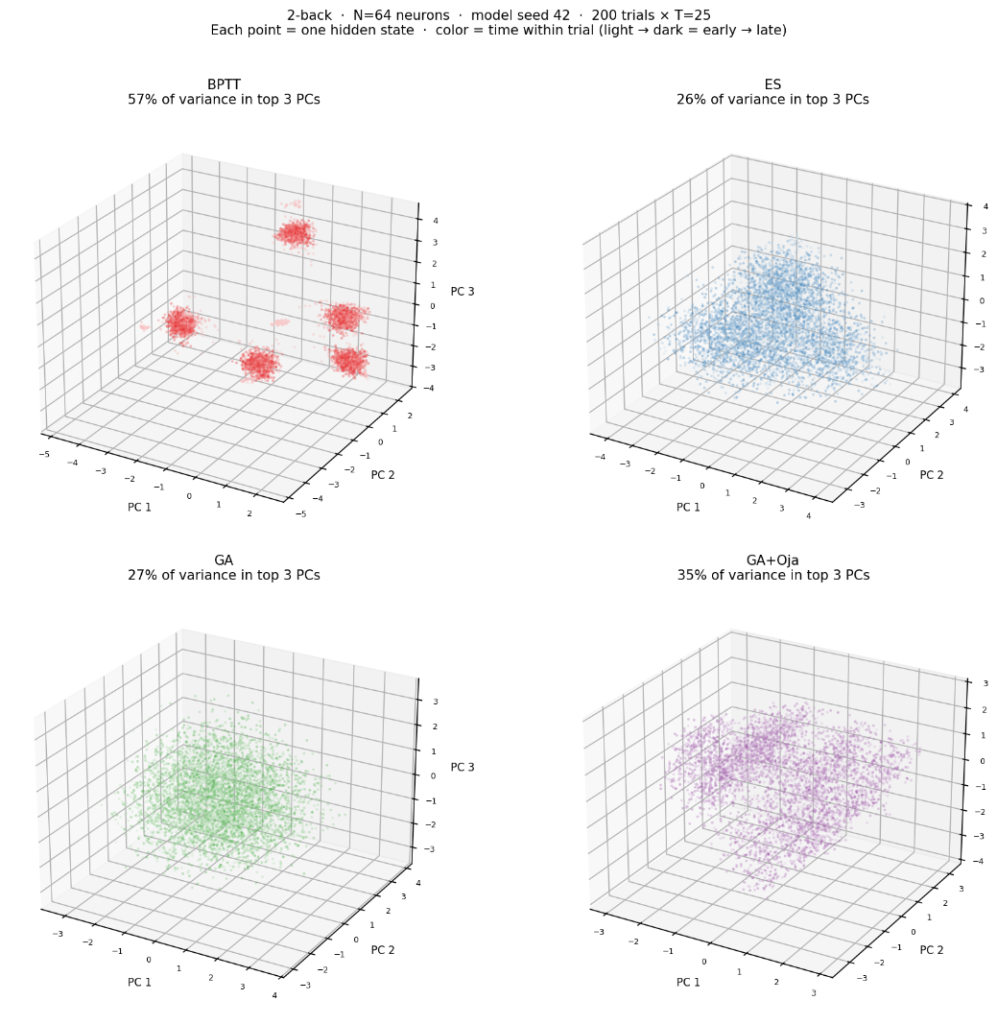
We compare four training methods (BPTT, ES, GA, and GA+oja in the figure below, which progress from least to most biologically grounded) on two tasks and assess how rnn connectivity and activity changes through training. We find that all training methods yield successful learning, but the more biologically grounded methods produce richer, higher-dimensional connectivity and dynamics. so different training methods do come with different biases! we encourage future modeling studies to compare results across multiple training methods before drawing conclusions about neural computation.
Inhibitory neurons for learning
- Yuqing Zhu, Chadbourne M.B. Smith, Tarek Jabri, Mufeng Tang, Franz Scherr, Jason MacLean. (2026). Task success in trained spiking neural network models coincides with emergence of cross-stimulus-modulated inhibition. Biological Cybernetics. https://doi.org/10.1007/s00422-025-01030-4.
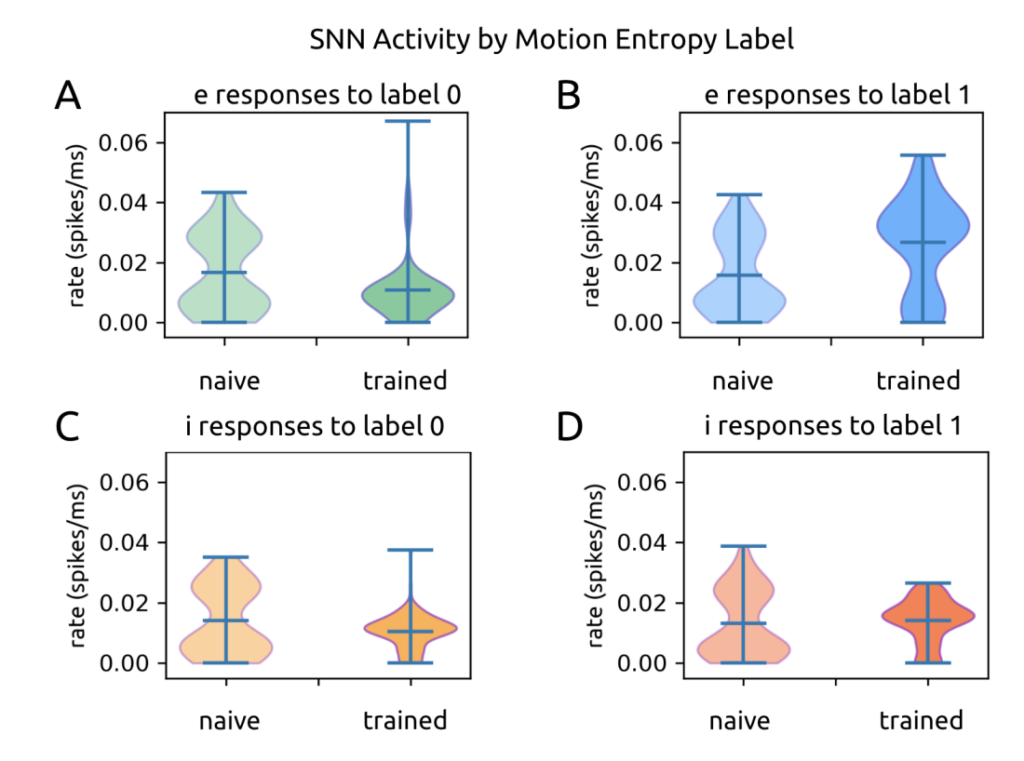
neurons in the brain change their synaptic connections during learning. These changes lead to new patterns of neural activity that support new behaviors. can we point to a specific connectivity change that supports a specific new behavior? why yes! we train spiking neural network (snn) models of the brain to complete a binary task (distinguishing between “motion entropy” levels, as in the figure below), and we find that inhibitory neurons strengthen and weaken their connections and modulate their activity in specific ways. if we disrupt these changes, the network does not learn the task. if we do not ask the network to learn the task, these changes do not occur. excitatory neurons typically get most of the credit, but inhibition is also key for learning.
Triangles of activity for stability
- Kyle Bojanek*, Yuqing Zhu*, Jason MacLean. (2020). Cyclic transitions between higher order motifs underlie sustained asynchronous spiking in sparse recurrent networks. PLOS Computational Biology. https://doi.org/10.1371/journal.pcbi.1007409. *co-first-authors.
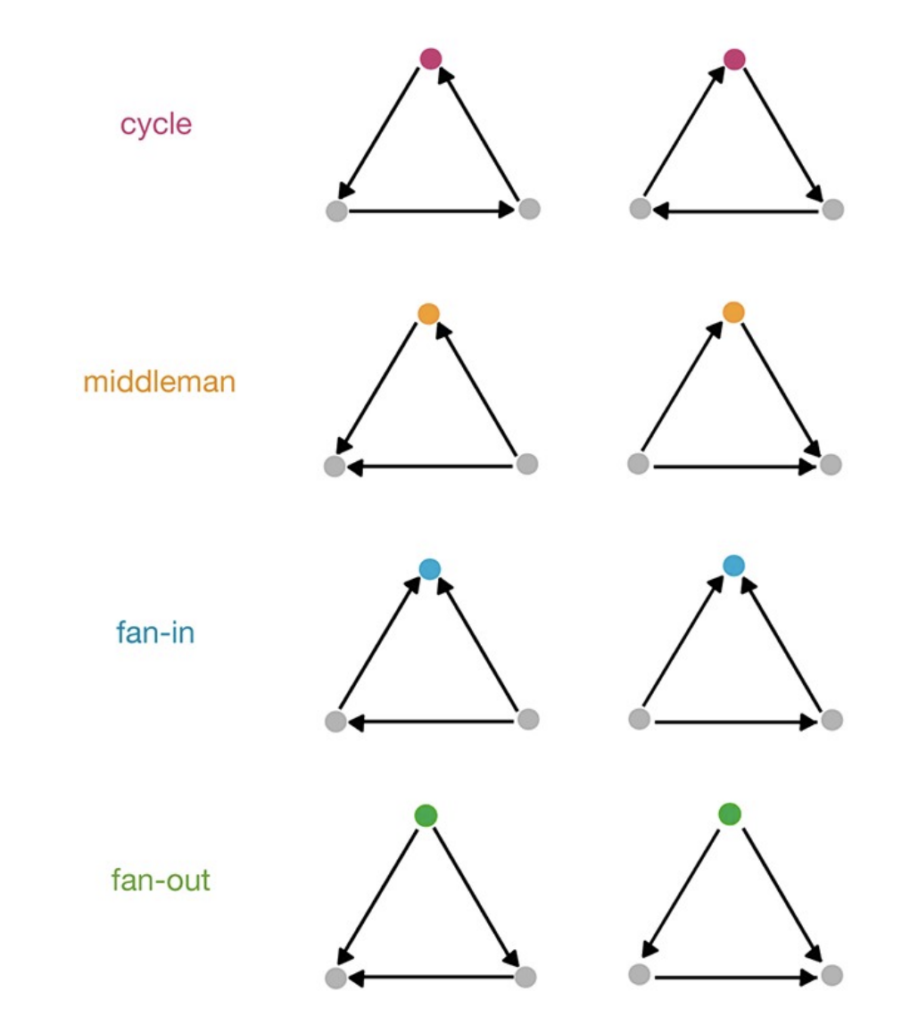
the brain needs to maintain overall stable neuronal activity over an animal’s lifespan. this is not trivial, because many circumstances change over time. in this paper, we show that stability in snn models of the brain relies upon specific three-neuron patterns (triangles!) of activity that repeat over time.